Antique Auctions in Australia
While antique auctions in Australia are not as commonplace as you’d find in the UK or US, but do offer surprisingly good value and a surprising array of items that appear from unique private collections.
There are auctioneers holding regular sales such as Bonhams, Shapiro, Raffan Kelaher & Thomas, Gibson’s, Leonard Joel, Lawsons, BHA, and Christian McCann. While you can also find occasional sales at any auctioneer and of course as part of larger estate sales.
When we come across antiques at auction we add sale notices to our Art, Antiques & Collectables category.
Latest notices
 Keith Stackpole & Paul Kennelly Sporting Memorabilia Auction - Leski Auctions is rolling out a showcase of sporting memorabilia, with collections from Keith Stackpole and Paul Kennelly on offer.… ...
 Important Australian, British, World & Ancient Coins, Banknotes, and Medals Auction - Noble Numismatics Auction Sale 141 in Sydney, NSW Sale 141 is now live and will take place online from the… ...
 Two Day Special Melbourne Estate Auction - Two Day Special Auction by Ainger Ainger will conduct a two-day special auction on Saturday, 28 March, and Sunday, 29… ...
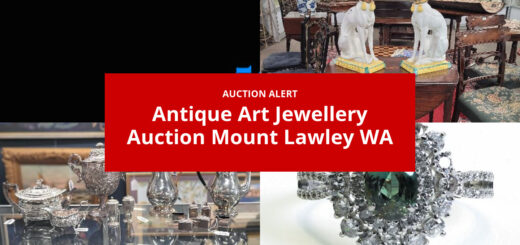
 Antiques, Art, & Jewellery Auction – WA - Antique, Art, Jewellery Auction in Mount Lawley, WA An online auction hosted by Donelly Auctions is open for viewing and… ...
 Upcoming Antique & Collectable Auctions in Australia (10 Event Listings) - This week there are 10 current and upcoming auctions in Australia featuring antiques and collectables, from 14/03/26. This list is… ...
 Unique Items & Art Auction inc. 200 y/o Pistol, 1914-18 War Medals & More - Roxbury's Auction House will hold a Signature Sale featuring unique items and artworks, which includes a selection highlighted in this… ...
 Upcoming Art Auction inc. works by Pro Hart, Paddy Carlton & More – WA - Upcoming Art Auction by GFL Fine Art in Nedlands, WA GFL Fine Art presents selected unsold lots from their recent… ...
Beginners guide to buying antiques at auction
With a lot of antique auctions, beauty, and value can be in the eye of the beholder (or bidder!). Possibly the most important duty when buying expensive antiques is validating their authenticity. This can be via documentation provided (which needs to be authenticated itself) or via industry professionals.
The library can be a useful resource, as well as the internet, for researching antique items. Also see: http://www.carters.com.au/ and
What is an Antique?
An antique is generally considered to be 70 to 100 years old. This is of course not the only determining factor in its overall worth as we shall see. Value is determined by many factors, age, limited production or rarity, uniqueness, quality, and individual taste. For example, some of today’s mass-produced furniture would not be valuable in 100 years probably (and we always have to say that, because who knows?) because they would be far too plentiful, of inferior workmanship, and not particularly unique. Whereas the local furniture maker who is making everything painstakingly perfect in his home shop and with the highest of standards would be a much more likely candidate for antique status in 100 years.
How do you tell what is an antique?
There are many telltale signs that one can begin to discern right away. This is a subject that requires much research and learning and cannot be entered into lightly as one could easily spend a fortune with nothing to show except some very fine re-productions or even forgeries!
Handy things to take to the auction:
A measuring tape – if you are buying antique furniture for the home it is worth knowing it will fit where you want it to!
A torch – Auction rooms and warehouses can typically be very dark and a torch is useful for inspecting the nooks and crannies of a piece that may be hiding scratches, cracks, etc., or for finding manufacturer marks and signatures. A magnifying glass is also useful.
Reference guides – reference guides, such as Carter Price Guides to Antiques, can be handy for clarifying details about the specific items you are viewing.
Also never be afraid to ask questions, most auction centre staff can be quite helpful if you ask the right questions. There is also much to gain from a good inspection of items before sale, look for shoddy repairs, and again for anything that may shed doubt on its authenticity.